Which Regulations Actually Favor Blockchain? A Quick Reference Guide
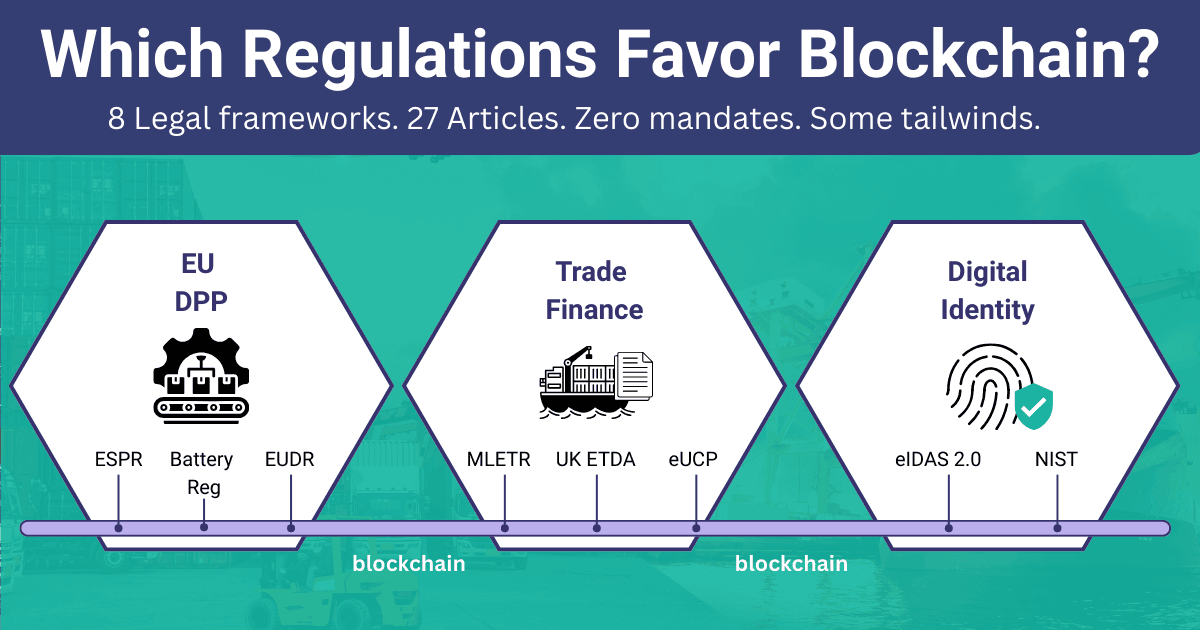
No regulation mandates blockchain. Not ESPR, not MLETR, not eIDAS 2.0. They are all technology-neutral.
But some articles create compliance requirements that blockchain can satisfy more efficiently than cloud infrastructure, especially in multi-party scenarios where multiple organizations need to verify each other's data. This reference guide maps the specific articles to their blockchain impact so you can check whether your use case has regulatory tailwinds or not.
How to Read This Guide
Each table below covers one regulation. The columns:
- Article: the specific article or section number
- Requirement: what the regulation demands
- Blockchain Impact: whether blockchain helps satisfy the requirement, and why
"Helps" means blockchain reduces the cost or complexity of compliance. "Neutral" means cloud infrastructure satisfies the requirement equally well.
Which DPP Regulations Create Blockchain Tailwinds?
ESPR (EU 2024/1781) ↗
The Ecodesign for Sustainable Products Regulation is the framework regulation for Digital Product Passports across all product categories.
| Article | Requirement | Blockchain Impact |
|---|---|---|
| Art. 10(1)(d) | DPP data must use open standards, no vendor lock-in, machine-readable, transferable | Helps. W3C VCs + IOTA are open standards. AWS-specific APIs create vendor dependency. |
| Art. 11(g) | Data authentication, reliability, and integrity shall be ensured | Helps. Cryptographic notarization is verifiable by any external party. Cloud audit logs (CloudTrail) require trusting the infrastructure operator. |
| Art. 40 | Products must not be designed to detect testing (anti-circumvention) | Helps. Notarized test results on immutable ledger are externally verifiable without trusting the operator's setup. |
| Recital 41 | DPP should be based on a decentralised data system | Helps. Non-binding preamble, but expresses clear legislative intent favoring decentralised architecture. |
| Art. 11(c) | Data stored by economic operator or DPP service providers | Neutral. Decentralised storage does not require blockchain. Cloud S3 buckets distributed across regions also qualify. |
| Art. 9(1) | Products must have a DPP before market placement; data must be accurate, complete, up to date | Neutral. A cloud database satisfies this. Multi-party updates benefit from blockchain but are not required. |
Threshold: blockchain's cost advantage appears at 5+ organizations needing cross-border verification of each other's data.
Battery Regulation (EU 2023/1542) ↗
The Battery Regulation was the first EU regulation to require a product-specific Digital Product Passport, with mandatory battery passports starting February 2027.
| Article | Requirement | Blockchain Impact |
|---|---|---|
| Art. 77(5) | Battery passport must use open standards, interoperable, no vendor lock-in | Helps. Same anti-vendor-lock-in language as ESPR. Cloud platforms with proprietary APIs may introduce interoperability constraints depending on architecture. |
| Art. 78(a) | Battery passport must be fully interoperable with other DPPs required by EU ecodesign law | Helps. Interoperability across multiple DPP systems (batteries, electronics, textiles) favors shared standards like W3C VCs. |
| Art. 78(g) | Data authentication, reliability, and integrity shall be ensured | Helps. Same as ESPR Art. 11(g). External verifiability without trusting the data provider's infrastructure. |
| Recital 126 | Battery passport should be based on a decentralised data system | Helps. Non-binding recital, but explicitly states the battery passport "should be based on a decentralised data system." Stronger language than ESPR Recital 41. |
Threshold: strongest case at 5+ interconnected DPP systems (batteries, vehicles, electronics, recyclers, regulators).
EUDR (EU 2023/1115) ↗
The EU Deforestation Regulation requires operators to prove products are deforestation-free with verifiable geolocation data.
| Article | Requirement | Blockchain Impact |
|---|---|---|
| Art. 9(1)(g) | Operators must collect verifiable information that products are deforestation-free | Helps. Blockchain notarization provides cryptographic proof of when satellite imagery or audit reports were captured. Cloud solutions can timestamp data, but verification requires trusting the operator's configuration. |
| Art. 9(1)(d) | Operators must collect geolocation (6 decimal precision) + production date/time | Conditional. Single-operator: cloud is fine. 50+ operators across 27 Member States: blockchain's shared verification layer wins. |
| Art. 12(5) | Due diligence documentation must be kept for 5 years | Neutral. Long-term retention is cloud's strength. Blockchain adds tamper-evidence but increases cost. |
Threshold: blockchain helps when 50+ operators need cross-border verification. Below that, cloud with digital signatures works.
Do Trade Finance Standards Favor Blockchain?
UNCITRAL MLETR (2017) ↗
The Model Law on Electronic Transferable Records provides the legal framework for digitizing negotiable instruments (bills of lading, promissory notes). Adopted by 11 jurisdictions including UK, France, Singapore, and Abu Dhabi.
| Article | Requirement | Blockchain Impact |
|---|---|---|
| Art. 10(1)(b)(i) | Reliable method must identify the electronic record as THE electronic transferable record (singularity) | Helps strongly. Blockchain's unique object ID inherently satisfies singularity. Cloud database records can be duplicated. This is the strongest pro-blockchain article across all regulations reviewed. |
| Art. 11 | Reliable method must establish exclusive control and identify the person in control | Helps. Blockchain object ownership enforces exclusive control at protocol level. Cloud IAM enforces access control, but a root account holder retains override capability. |
| Art. 10(1)(b)(ii) | Electronic record must be subject to control from creation until it ceases to have effect | Helps. Blockchain enforces control throughout lifecycle via transaction history. Cloud requires application-layer enforcement. |
Threshold: strongest case for negotiable instruments (bills of lading, promissory notes) worth $1M+ per document, processed at >10,000/year across multiple banks and jurisdictions.
UK ETDA (2023) ↗
The Electronic Trade Documents Act is the first common law jurisdiction to codify electronic trade documents, closely following MLETR principles.
| Article | Requirement | Blockchain Impact |
|---|---|---|
| Section 2(2)(a) | System must identify document so it can be distinguished from any copies (singularity) | Helps. Same as MLETR Art. 10. Blockchain object ID satisfies this. Cloud primary keys do not prevent copying. |
| Section 2(2)(c) | Not possible for more than one person to exercise control at any one time | Helps. Blockchain object ownership = one address at a time, enforced at protocol level. |
| Section 2(2)(e) | Transfer must deprive the previous controller of ability to exercise control | Helps. Blockchain transfer atomically removes sender's control and grants receiver's. Cloud requires application logic that can be bypassed or fail. |
Threshold: if operating only in UK with 1-2 trade partners, a certified cloud platform is cheaper. If operating globally across 10+ jurisdictions with 50+ partners, blockchain's borderless architecture wins.
ICC eUCP v2.1 ↗
The Supplement to the Uniform Customs and Practice for Documentary Credits (UCP 600) governing electronic presentation of trade documents under letters of credit.
| Article | Requirement | Blockchain Impact |
|---|---|---|
| Art. e3(b)(iii) | Electronic record must be authenticated as to sender identity and source, and verified as complete and unaltered | Helps. Blockchain notarization provides cryptographic proof verifiable by any party (issuing bank, advising bank, beneficiary). Cloud with CloudTrail requires each bank to trust the other's infrastructure. |
| Art. e3(b)(v) | Definition: electronic transferable record contains equivalent information to paper document | Neutral. This defines what the record must contain, not how it must be stored. The blockchain advantage for negotiable instruments comes from singularity and control requirements (see MLETR analysis). |
Threshold: below 1,000 trade documents/year, cloud + manual verification is cheaper. Above 10,000/year across multiple banks, blockchain's shared verification saves audit and fraud investigation costs.
How Do Digital Identity Frameworks Align with Blockchain?
eIDAS 2.0 (EU 2024/1183) ↗
The updated EU regulation on electronic identification and trust services, introducing the EU Digital Identity Wallet and qualified electronic ledgers.
| Article | Requirement | Blockchain Impact |
|---|---|---|
| Art. 45k | Qualified electronic ledgers must ensure unique sequential chronological ordering and data integrity over time | Helps. This article defines what a "qualified electronic ledger" is. Blockchain naturally provides chronological ordering + integrity + origin proof, closely aligning with these requirements. The IOTA Trust Framework implements this via IOTA Notarization. |
| Art. 5a(16) | EUDI Wallet must NOT allow tracking, linking, or correlation of transactions (privacy-preserving) | Helps. Selective disclosure (supported by IOTA Identity via SD-JWT) enables presenting only required attributes. Centralised identity providers see all interactions. |
| Art. 45b | Qualified electronic attestations of attributes have same legal effect as paper | Conditional. W3C VCs are EAA-compatible. Cloud credential systems also work but lack decentralised verification. |
The EU's EBSI (European Blockchain Services Infrastructure) is already piloting qualified electronic ledgers and verifiable credential issuance on blockchain, validating this architectural direction at institutional level.
Threshold: blockchain is preferred when multi-party verification and unlinkable identity attestations are required. For internal SSO, cloud identity providers (Okta, Auth0) remain cheaper.
NIST SP 800-63-4 (US, 2025) ↗
The US Digital Identity Guidelines introducing subscriber-controlled wallets and recognizing verifiable credentials.
| Section | Requirement | Blockchain Impact |
|---|---|---|
| IAL2 | Identity proofing recognizes verifiable credentials as valid identity evidence | Helps. NIST recognizes verifiable credentials as valid identity evidence, creating a pathway for DID-based identity in US federal supply chains. |
| SP 800-63C-4 | Subscriber-controlled wallet model: user controls wallet containing attribute bundles and signing keys | Helps. This is the Self-Sovereign Identity model that IOTA Identity implements. Cloud identity providers do not give users control of their credentials. |
| AAL3 | Requires phishing-resistant authenticators with hardware-bound public-key cryptography | Helps. AAL3 requires FIDO2/WebAuthn hardware authenticators. DID-based wallets complement this with verifier impersonation resistance through Domain Linkage (DID bound to DNS domain). Cloud username/password + 2FA does not satisfy AAL3. |
Threshold: 1 organization verifying 10 users: cloud SSO is cheaper. 1,000 organizations verifying each other across 50 jurisdictions: decentralized identity scales better.
Summary: Where Blockchain Has Regulatory Tailwinds
| Regulatory Theme | Key Articles | Blockchain Advantage | When Cloud Is Enough |
|---|---|---|---|
| Open standards, no vendor lock-in | ESPR Art. 10(1)(d), Battery Reg Art. 77(5) | W3C VCs + open protocols satisfy the requirement natively. Proprietary cloud APIs create compliance risk. | Single vendor ecosystem with no interoperability mandate. |
| Data integrity + external verifiability | ESPR Art. 11(g), Battery Reg Art. 78(g), eUCP Art. e3(b)(iii) | Cryptographic proof verifiable by any party without trusting the operator. | Internal audit only, no external verification by third parties. |
| Singularity + exclusive control | MLETR Art. 10-11, UK ETDA Section 2(2) | Protocol-level enforcement. No root account override. | Non-negotiable documents (invoices, receipts, packing lists). |
| Decentralised architecture | ESPR Recital 41, Battery Reg Recital 126, eIDAS Art. 45k | Satisfies legislative intent and qualified electronic ledger definitions. | Fewer than 5 participants, no cross-border verification. |
| Self-sovereign identity | eIDAS Art. 5a(16), NIST SP 800-63C-4 | User-controlled wallets, unlinkable attestations, phishing-resistant auth. | Single organization, internal user management only. |
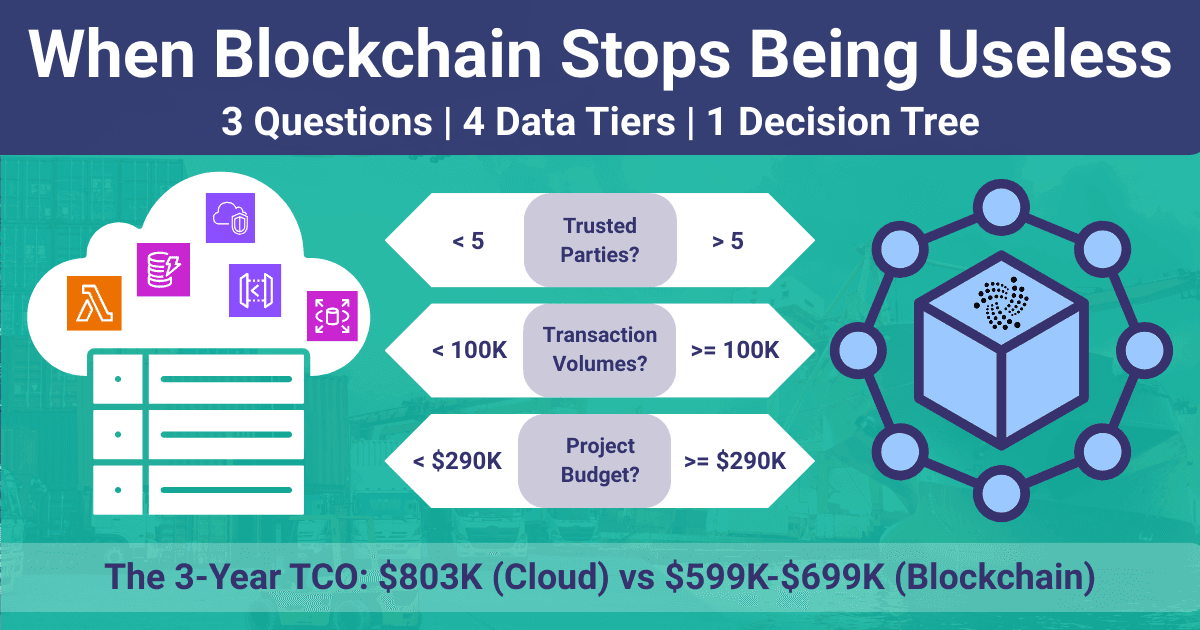
The pattern across all 8 regulations and standards: blockchain's compliance advantage scales with the number of parties that need to verify each other's data without trusting a central administrator. Below 5 parties, cloud wins on cost. Above 8 parties with cross-border verification, blockchain wins on both cost and compliance defensibility.
For the economic side of this analysis, see the companion article: Why Blockchain Is Useless (And the Math That Changed My Mind). It includes a 3-year TCO model comparing AWS against the IOTA Trust Framework and a 60-second decision tree.
⚠️ Disclaimer: This analysis is for informational purposes. Regulation citations reference the official texts linked throughout this article. Consult qualified legal counsel for binding compliance decisions.
Need help implementing Compliance?
Schedule a free consultation to explore how KChain Solutions can help your organization implement production-grade blockchain architecture.

Valerio Mellini
Founder & IOTA Foundation Solution Architect
10+ years in software architecture across Accenture, PwC, Wolters Kluwer, and Ubiquicom. Certified Blockchain Solutions Architect. Helping enterprises implement production-grade blockchain systems with architecture-first methodology.