Why Blockchain Is Useless (And the Math That Changed My Mind)
I'm a blockchain consultant. Most of the time, I tell prospects not to use blockchain.
That's not a positioning trick. It's the math. Most enterprise blockchain pilots fail because teams choose blockchain when cloud infrastructure would have been cheaper, faster, and easier to maintain. Gartner's 2024 research shows that 75-80% of blockchain pilots don't reach production. The conversion rate from proof-of-concept to live deployment sits between 20-25%. The failure isn't technical. It's economic.
Most use cases don't need multi-party trust. They need a database with good access controls. When I open an architecture assessment, the first question isn't "which blockchain?" It's "how many organizations need to verify each other's data without trusting a central database administrator?" If the answer is fewer than five, the conversation usually ends there.
This article gives you the exact math I use to make those calls. You'll see a 3-year total cost of ownership model comparing cloud infrastructure to the IOTA Trust Framework. You'll get a three-question framework that filters out 90% of bad blockchain decisions before any code is written. You'll see a decision flowchart that works in 60 seconds. And you'll understand when blockchain stops being useless and starts being the only architecture that makes sense.
What $242/Month Buys You on AWS
Before comparing blockchain vs cloud, you need to know what cloud infrastructure actually costs. Not the pricing calculator estimate. The real monthly bill for a production Digital Product Passport system serving 50,000 products across 20 suppliers.
| AWS Service | Monthly Cost | Notes |
|---|---|---|
| RDS PostgreSQL | $195 | db.t4g.medium ($87) + backups ($21) + standby replica ($87) |
| KMS | $3 | 3 keys (database, S3, API tokens) at $1/key |
| CloudTrail | $2.60 | Audit logging, 100K events/month |
| S3 Object Lock | $0.06 | 2.5GB storage, immutability included |
| Lambda + API Gateway | $23-$50 | 1M requests/month, 512MB, incl. CloudWatch + data transfer |
| Total Infrastructure | $242/month | Realistic production cost: $400-$600 with monitoring |
Cloud infrastructure is good. Really good. It scales, it's reliable, AWS handles the operational burden, and the pricing is predictable. The question is not "can cloud do this?" The question is "when does cloud stop being enough?"
The 3-Question Framework: When Does Blockchain Stop Being Useless?
Most blockchain decision frameworks are too complicated. They ask 20 questions about data privacy, regulatory compliance, transaction costs, latency thresholds, and consensus mechanisms. By question five, the team is confused. By question twelve, they're guessing.
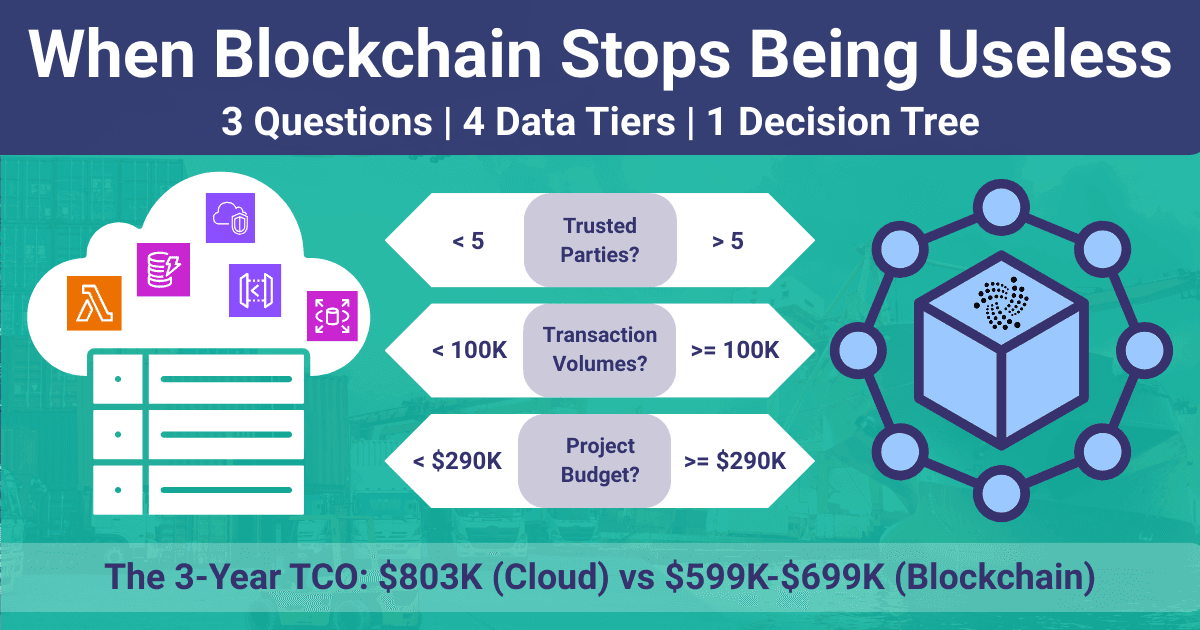
This framework has three questions. If you answer "cloud" to all three, you don't need blockchain. If you answer "evaluate blockchain" to at least two, keep reading. If you answer "Trust Framework" to all three, blockchain is justified.
Question 1: How Many Parties Need to Trust Each Other?
Count the distinct organizations that need to write data, read data written by others, and verify that what they're reading hasn't been modified by a single administrator.
| Number of Organizations | Recommendation | Why |
|---|---|---|
| Fewer than 5 | Use cloud infrastructure | AWS IAM, row-level security, CloudTrail handle multi-party access. No trust problem severe enough to justify blockchain overhead. |
| 5 to 8 | Evaluate | If contractual trust exists (joint ventures, regulated partners), cloud may work. If trust is adversarial (competitors, banks + customs), blockchain viable. |
| More than 8 | IOTA Trust Framework | Coordinating read/write permissions across 10+ orgs in central database becomes expensive. Cost of coordination exceeds cost of decentralized protocol. |
Scenario: A battery manufacturer with 40 suppliers across 8 countries needs a DPP system for compliance under EU Regulation 2023/1542. Each supplier logs production data. Customs agencies verify export documents. Recyclers record end-of-life processing. The manufacturer doesn't trust the recycler's database. The recycler doesn't trust the manufacturer's cloud account. Blockchain solves the coordination problem.
Question 2: What's Your Annual Transaction Volume?
Transaction volume determines whether blockchain's per-transaction cost is competitive with cloud API pricing.
| Annual Transaction Volume | Recommendation | Cost Analysis |
|---|---|---|
| Fewer than 10,000 | Cloud costs less | AWS Lambda: $0.002/year. IOTA: $3.30/year. Lambda wins by 3 orders of magnitude when including setup costs. |
| 10,000 to 100,000 | It depends | Per-transaction cost gap narrows (IOTA $33/year at 100K, Lambda $2/year), but Year 1 blockchain setup ($340K) vs cloud ($287K) still favors cloud unless multi-party trust (Q1) is strong. |
| More than 100,000 | Blockchain can begin to show a total system cost advantage | IOTA scales linearly at $0.00033/tx. Cloud infrastructure scales faster when you factor in compute, storage, monitoring, logging, and audit requirements. At 500K transactions/year, IOTA transaction costs are $165. AWS infrastructure costs reach $3,430+ (Lambda $100, RDS scaling $2,400, S3 $150, CloudTrail $780). |
Question 3: What's Your 3-Year Budget?
Budget determines whether you can afford the Year 1 setup cost for blockchain infrastructure, even if long-term savings justify it.
| 3-Year Budget | Recommendation | Rationale |
|---|---|---|
| Less than $100K | Cloud only | Blockchain setup costs (architecture, developers, testnet, mainnet, supplier onboarding) exceed this. Use AWS with S3 Object Lock for immutability. |
| $100K to $290K | Cloud with migration path | Start with cloud. Design data model for future blockchain migration (repository pattern, interface-driven design). Swapping persistence layer costs $50K-$100K instead of $200K-$400K. |
| More than $290K | Evaluate IOTA Trust Framework | Year 1 blockchain costs affordable. 3-year savings (13-25% vs cloud) plus stronger compliance defensibility justify investment. |
If you answered "cloud" to all three questions, stop here. You don't need blockchain. If you answered "evaluate" or "Trust Framework" to at least two, keep reading. The next section shows you the total cost of ownership model that drives these decisions.
Why Year 1 Costs Are Only Half the Story
Most blockchain pilots I've reviewed underestimate total cost of ownership, often by a factor of two to three. The initial budget covers Year 1 development. It rarely covers maintenance, audits, supplier onboarding, or integration costs that recur annually.
Here's the 3-year TCO for a realistic Digital Product Passport system serving 50,000 products across 20 suppliers. Two architectures: cloud-based (AWS) and blockchain-based (IOTA Trust Framework).
3-Year Total Cost of Ownership: Cloud vs IOTA Trust Framework
| Cost Category | Cloud (AWS) | IOTA Trust Framework | Delta |
|---|---|---|---|
| Year 1 Build | $287,000 | $340,000 | +$53,000 (IOTA) |
| Architecture, backend, frontend, security audit | 2 architects (3 mo) + 3 developers (8 mo) | 2 architects (3 mo) + 3 developers (10 mo), Move smart contracts, HSM | 25% premium for blockchain learning curve |
| Ongoing Operations (3 years) | $162,000 | $70,000 | -$92,000 (savings) |
| Infrastructure, maintenance, security patches | 1.5 FTE at 20% of Year 1 cost/year | 0.5 FTE, HSM renewal, Gas Station, protocol updates. W3C standards reduce custom code. | IOTA transactions: $33/year (100K tx) |
| Compliance Audits (3 years) | $102,000 | $41,000 | -$61,000 (savings) |
| External third-party verification | 2 audits/year at $17K each ($34K/year) | Cryptographic proofs reduce scope 60%. Auditors verify smart contract once, rely on immutability. $14K/year. | Single DB admin can modify cloud records = more audits |
| Supplier Integration | $252,000 | $48,000 | -$204,000 (savings) |
| API provisioning, credentials, training | $58K upfront + $97K/year ongoing (credential rotation, schema changes, re-onboarding) | $10K upfront + $19K/year. W3C Verifiable Credentials (tamper-proof digital attestations that any party can verify without contacting the issuer). Suppliers generate own DIDs. No custom provisioning. | Self-sovereign identity eliminates admin overhead |
| Supplier Onboarding | $0 | $100,000-$200,000 | +$100K-$200K (IOTA) |
| Change management, key custody, training | Suppliers familiar with web portals and API keys | Educational workshops, hands-on support for blockchain-unfamiliar suppliers ($5K-$15K per supplier) | One-time cost, higher for legacy orgs |
| 3-Year Total | $803,000 | $599,000-$699,000 | -$104K to -$204K (13-25% savings) |
Cost Disclaimer: All cost estimates in this article are indicative and based on EU Western/Southern salary rates, AWS US East pricing, and IOTA transaction costs as of March 2026 ($0.066 per IOTA). Your actual costs will vary depending on region, team composition, transaction volume, and infrastructure requirements. Use these figures as relative comparisons, not absolute budgets. Contact us for a customized TCO model with your specific parameters.
Where the Savings Come From
The IOTA Trust Framework costs 13-25% less over three years. The savings come from three sources:
- Audit cost reduction: $61,000 over 3 years. Cryptographic proof reduces audit scope by 60%. Auditors verify the smart contract once, then rely on immutability guarantees.
- Integration cost reduction: $204,000 over 3 years. DIDs (Decentralized Identifiers) are self-sovereign. Suppliers generate their own credentials. The IOTA Trust Framework layer verifies credentials permissionlessly. No custom API provisioning. No admin overhead.
- Maintenance cost reduction: $92,000 over 3 years. W3C standard components and backward-compatible protocol upgrades reduce custom code maintenance.
Where the Costs Offset
Blockchain has two cost offsets that reduce the 3-year savings:
- Higher Year 1 cost: $53,000. Blockchain architecture and smart contract development cost more upfront ($340K vs $287K). This is a one-time investment.
- Supplier onboarding: $100,000 to $200,000. Suppliers unfamiliar with blockchain need educational workshops and hands-on support. Cloud-based systems have lower onboarding costs because suppliers are familiar with web portals and API keys, but the cost is not zero. It depends on system complexity, documentation quality, and how well the APIs integrate with suppliers' existing tools.
The Real Insight
At 3 years, the value isn't cost reduction. It's comparable cost with stronger compliance defensibility. You pay roughly the same ($599K to $699K for blockchain vs $803K for cloud), but the blockchain version has immutable audit trails that no single party can modify. This matters for EU regulatory environments where Article 10(1)(d) of the ESPR requires vendor-neutral, open-standard infrastructure.
At 5 years, savings grow to 25-35% because onboarding is a one-time cost but maintenance savings recur. Blockchain's economic case improves with time.
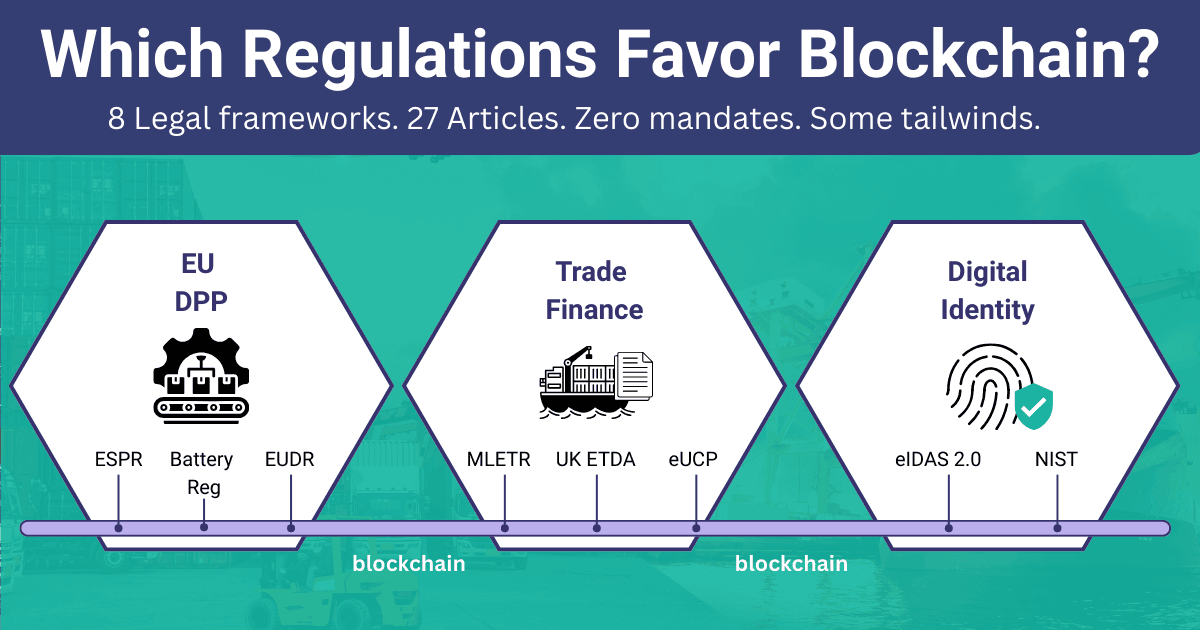
For an article-by-article breakdown of which regulations create blockchain tailwinds, see the companion guide: Which Regulations Actually Favor Blockchain?
What Should Go On-Chain? Four Data Exposure Tiers
One architectural question kills more blockchain projects than any other: "What data should we put on-chain?"
The answer depends on transaction volume, confidentiality requirements, and how many parties need to verify the data. There are four tiers. Each tier has a different break-even point.
| Tier | What Goes On-Chain | Break-Even Point | Use Case | Example |
|---|---|---|---|---|
| Tier 1: Hash-Only | SHA-256 hash only. All data stays off-chain (database, S3, IPFS). | >500,000 tx/year | Maximum privacy. Confidential product data, trade secrets, financial records, clinical trials. | Trade Finance Document Validator: notarizes combined hash of Bill of Lading, Commercial Invoice, Letter of Credit. Documents remain off-chain. |
| Tier 2: DID Documents | Decentralized Identifiers (DIDs) on-chain. Verifiable Credentials (VCs) off-chain. | >100,000 tx/year | KYB (Know Your Business), supplier identity, regulatory compliance. Manufacturer issues credentials to suppliers. DID on-chain, credential off-chain. | IOTA Trust Framework: IOTA Identity for DID management. Each participant has DID on-chain. Credentials (compliance status) exchanged off-chain via W3C standards. |
| Tier 3: Public Metadata | Product lifecycle data on-chain (manufacturing date, ownership, recycling, compliance flags). Sensitive data off-chain (trade secrets, pricing, routes). | >50,000 tx/year | Regulatory transparency, multi-party verification where confidentiality isn't critical. Battery manufacturer publishes recycled content %, carbon footprint on-chain per EU Battery Regulation Article 77(5). | Most Digital Product Passport solutions: Product IDs, lifecycle events, compliance attestations on-chain. Technical specs and supplier pricing off-chain. |
| Tier 4: Distributed Storage | All data to distributed storage (IPFS, Swarm, Arweave). Blockchain stores content hashes (CIDs). | >50,000 tx/year + large files | Censorship resistance, long-term archival, decentralized apps. NGO publishing supply chain audit reports in adversarial country stores reports on IPFS, anchors CIDs on-chain. | Some NFT projects: image on IPFS, token metadata points to IPFS CID. No central server can delete the art. |
Tier Selection Guidelines
Most clients start with Tier 1 or Tier 2. Tier 3 and Tier 4 make sense when you have 20+ participants and regulatory requirements for public transparency.
The decision is not philosophical. It's economic. Match the tier to the transaction volume and confidentiality requirements:
- Tier 1 if confidentiality is critical and you have >500K tx/year (else off-chain storage costs exceed on-chain hash costs)
- Tier 2 if identity verification is core (KYB, supplier onboarding) and you have >100K tx/year
- Tier 3 if regulatory transparency matters (DPP compliance) and you have >50K tx/year
- Tier 4 if full decentralization is required (censorship resistance, no cloud dependency) and you have >50K tx/year + large files
Is Blockchain Vendor Lock-In Free? (Not Exactly.)
Blockchain advocates claim freedom from vendor lock-in. The claim is half-true.
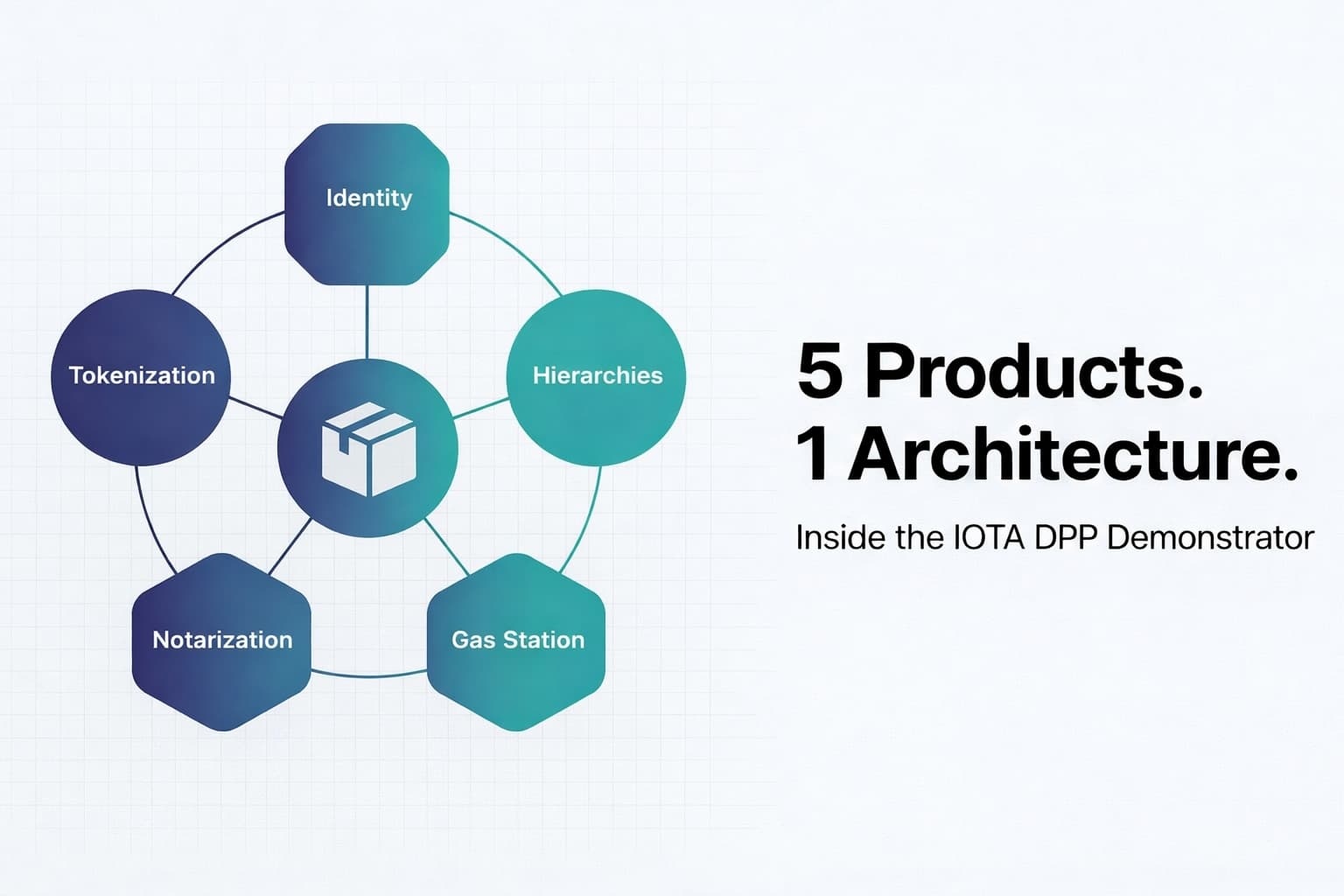
The IOTA Trust Framework is fully open-source under Apache 2.0 license. Every component (IOTA Identity, IOTA Hierarchies, IOTA Notarization, IOTA Gas Station, IOTA Secret Storage) is public, auditable, and forkable. No single company controls the codebase. The IOTA Foundation is a German non-profit. It cannot arbitrarily raise prices or shut down your infrastructure.
But protocol-level lock-in exists.
IOTA uses Move, a smart contract language designed for safe asset management with built-in ownership and access control. Ethereum uses Solidity. Migrating a smart contract from Move to Solidity costs $50,000 to $300,000 depending on complexity. You're not locked into a vendor. You're locked into a protocol. The difference matters.
Compare this to AWS lock-in. Migrating from DynamoDB to PostgreSQL costs $100,000 to $500,000 depending on schema complexity and data volume. Migrating from Lambda to Google Cloud Functions costs $50,000 to $200,000. You're locked into AWS-specific services (DynamoDB's key-value model, Lambda's event-driven architecture).
The Honest Framing: Blockchain is governance lock-in free, not vendor lock-in free.
- Governance lock-in free means no single company can raise your prices, change the terms of service, or shut down the network. AWS can increase RDS pricing by 20% and you have two choices: pay or migrate. IOTA cannot do this because the protocol is decentralized and governed by a non-profit foundation.
- Vendor lock-in still exists at the protocol level. Switching from IOTA to Ethereum or from Ethereum to Polygon requires rewriting smart contracts, migrating DIDs, and re-onboarding all participants. The cost is comparable to cloud migrations.
The key advantage: Protocols are harder to kill than companies. AWS rarely discontinues core services, but it can change pricing or deprecate features with limited notice. A decentralized blockchain protocol survives as long as validators keep running nodes. If the IOTA Foundation dissolved tomorrow, the network would continue operating. If AWS dissolved tomorrow, every service would go offline.
For industries where 10-year to 30-year infrastructure stability matters (energy grids, supply chain registries, public health records), protocol resilience outweighs vendor neutrality. The infrastructure doesn't depend on a single company's quarterly earnings.
The 60-Second Blockchain Decision
This decision tree works in 60 seconds. Start at the top. Answer each question. Follow the path.

The tree eliminates 90% of bad decisions at the first question. If fewer than five organizations need multi-party trust, blockchain overhead isn't justified. If transaction volume is below 100,000 per year and the trust requirement isn't adversarial, cloud infrastructure wins.
If you reach the data tier question, blockchain is viable. The choice between Tier 1, Tier 2, Tier 3, or Tier 4 depends on confidentiality requirements and regulatory context.
Need help implementing compliance or evaluating blockchain vs cloud? Our team has built production systems on both AWS and the IOTA Trust Framework. We can run the TCO model with your actual numbers.
Schedule a ConsultationWhen Blockchain Stops Being Useless
Most prospects I work with don't need blockchain. But consider this scenario: a battery manufacturer with 40 suppliers across 8 countries needs a compliance system for EU Battery Regulation Article 77. 20+ organizations need to write data, verify each other's records, and prove to regulators that no single party modified the audit trail. Transaction volume: 200,000 per year. Budget: $450,000 over 3 years.
That's when blockchain stops being useless.
Running the TCO model above with these parameters: cloud would cost $803,000 over three years. The IOTA Trust Framework would cost $650,000 with supplier onboarding included. The savings: $153,000. The compliance defensibility would be stronger because immutable audit trails mean fewer disputes with regulators.
Blockchain isn't useless. It's specialized. It solves one problem exceptionally well: multi-party trust without a central administrator. If you don't have that problem, you don't need blockchain. If you do, cloud can coordinate the workflow, but it requires a central operator or heavier governance overhead to achieve the same trust guarantees.
The question is not "blockchain or cloud." The question is "how many parties, how many transactions, and how much trust?" Answer those three questions honestly. The architecture decision makes itself.
Need help implementing Blockchain?
Schedule a free consultation to explore how KChain Solutions can help your organization implement production-grade blockchain architecture.

Valerio Mellini
Founder & IOTA Foundation Solution Architect
10+ years in software architecture across Accenture, PwC, Wolters Kluwer, and Ubiquicom. Certified Blockchain Solutions Architect. Helping enterprises implement production-grade blockchain systems with architecture-first methodology.