AI and Blockchain in Trade Finance: Cooperation, Not Competition
Blockchain has lost part of its hype. That's undeniable. The transformation that AI is driving across every industry is equally undeniable, and it will only accelerate.
But does AI really solve all problems?
AI and blockchain are often framed as competing technologies. In practice, they solve fundamentally different problems. AI can read a trade finance document, cross-reference amounts against a Letter of Credit, flag regulatory discrepancies, and return a structured result in seconds. What it cannot do is prove that this validation happened, that the result wasn't modified after the fact, or that a third party can independently verify the claim. For that, you need a different kind of technology. A deterministic one.
We built a tool that uses both: AI validates five trade finance documents against ICC regulations, and blockchain notarizes the result on IOTA. You can try it right now.
This is not a theoretical article. The Trade Finance Document Validator is live. Upload documents (or use the provided templates), watch AI validate them against UCP 600 and Incoterms 2020, then notarize the result on IOTA testnet.
Try the Live Demo→Why AI and Blockchain Are Complementary, Not Competing
"Should we use AI or blockchain?" I hear this question every month, and it reveals a fundamental misunderstanding. It frames these technologies as alternatives when they are, in fact, complementary.
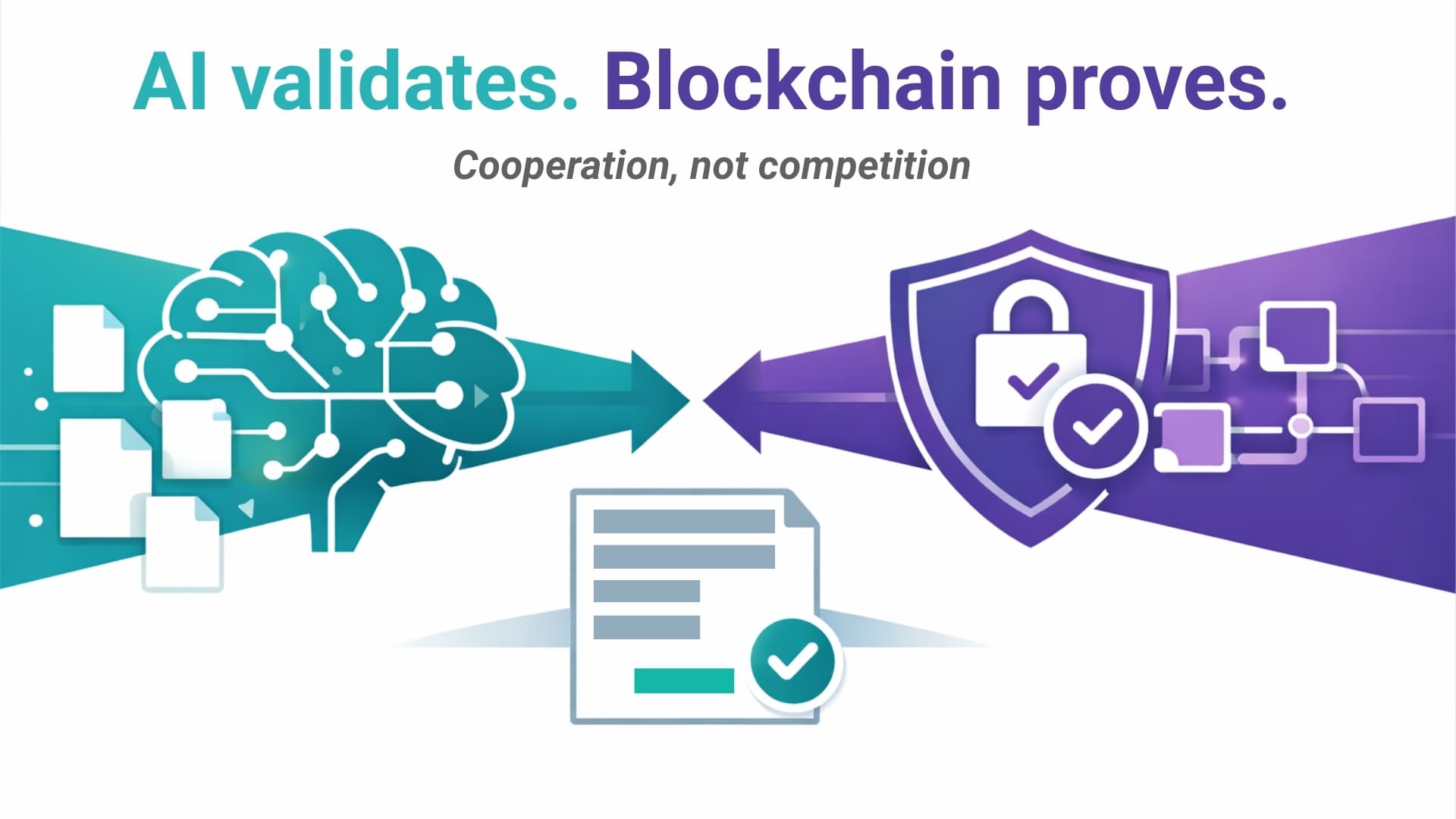
AI excels at non-deterministic tasks: pattern recognition, extracting structured data from PDFs, interpreting regulatory context. Blockchain excels at deterministic proof: immutability, timestamping, multi-party verification without centralized trust. AI is powerful precisely because it is flexible and probabilistic. Blockchain is valuable precisely because it is rigid and deterministic.
The question isn't "which technology." The question is "which capability for which step."
AI in Trade Finance: Document Validation and Its Limits
AI is excellent at several document validation tasks that blockchain simply cannot perform.
AI can:
- Extract structured data from unstructured documents (PDFs, images, scanned forms)
- Cross-reference data points across multiple documents (does the Commercial Invoice amount match the Letter of Credit?)
- Identify anomalies and inconsistencies against regulatory standards (UCP 600, ISBP 821, Incoterms 2020)
- Interpret context (e.g., whether a goods description in an invoice matches a Letter of Credit requirement)
- Provide actionable recommendations ("This date falls outside the allowed shipment window under ISBP 821")
AI cannot:
- Create tamper-proof proof that a validation happened
- Prove WHEN something was checked
- Guarantee that results haven't been modified after the fact
- Provide multi-party verification without trust in a central authority
- Prevent a single party from retroactively changing a validation record
This isn't a limitation to overcome. It's a capability boundary. AI operates in the realm of pattern recognition and interpretation. It does not operate in the realm of cryptographic proof.
Blockchain for Trade Documents: Proof and Its Limits
Blockchain provides deterministic proof capabilities that AI cannot replicate.
Blockchain can:
- Create immutable, timestamped records that no single party can alter
- Enable multi-party verification without centralized trust (banks, exporters, importers, customs all see the same audit trail)
- Provide cryptographic proof of document integrity (the SHA-256 hash recorded on-chain either matches the document or it doesn't)
- Anchor audit trails that persist even if the original parties go offline or disappear
- Support regulatory compliance scenarios where proof of WHEN validation occurred is critical
Blockchain cannot:
- Interpret the content of documents (it can store a hash, not read a PDF)
- Detect inconsistencies between document fields (it has no concept of "amount" or "party name")
- Apply regulatory judgment (e.g., "does this invoice comply with UCP 600 Article 18?")
- Process unstructured data like text, images, or tables
- Cross-reference information across multiple documents
This isn't a failure of blockchain technology. It's an architectural fact. Blockchain secures data. It does not interpret data.
How AI and Blockchain Work Together: The Cooperation Pattern
If AI can validate but not prove, and blockchain can prove but not validate, the solution is straightforward: compose them.
The pattern looks like this:
Documents → AI (interprets, validates, flags) → Structured output → Blockchain (anchors, proves, timestamps) → Immutable record
AI handles what requires intelligence. Blockchain handles what requires trust. Neither can replace the other. Each operates at its capability boundary. The output of AI becomes the input of blockchain.
This is not a new idea in software architecture. It's separation of concerns. But applying it to AI and blockchain together is still surprisingly uncommon, and getting the architecture design right from the start is critical.
Trade Finance Document Validation: A Working Example
Instead of theorizing, we built the Trade Finance Document Validator to demonstrate this cooperation pattern in a high-stakes environment: international trade finance.
The Problem
International trade generates approximately 4 billion documents per year. Trade finance fraud costs $2-5 billion annually. Document verification is manual, error-prone, and lacks tamper-proof audit trails. Banks, customs agencies, exporters, and importers all need to validate the same documents against ICC regulations (UCP 600, ISBP 821, Incoterms 2020), but they don't trust each other enough to share a central database.
This is a textbook case where AI and blockchain must cooperate.
How AI Contributes
The Trade Finance Document Validator showcase uses Claude Haiku to validate five trade documents: Bill of Lading, Commercial Invoice, Letter of Credit, Packing List, and Certificate of Origin.
AI performs 15+ cross-document checks:
- Do amounts match across Commercial Invoice and Letter of Credit?
- Do party names (shipper, consignee, notify party) match across documents?
- Are dates consistent (L/C expiry, latest shipment date, B/L date)?
- Do L/C references match across documents?
- Are Incoterms used consistently?
- Do ports of loading and discharge match across documents?
- Is the goods description in the invoice consistent with the L/C?
AI returns structured results:
- PASS: All checks passed
- WARNING: Minor inconsistencies detected (user can override)
- FAIL: Critical errors found (recommend correction)
Each result includes specific findings, regulation references, and recommendations (e.g., "Commercial Invoice amount exceeds L/C maximum. See UCP 600 Article 18").
Cost: Approximately $0.001 per validation (Claude Haiku, ~3,250 tokens per document set).
How Blockchain Contributes
After AI validation, the document set is notarized on IOTA testnet using IOTA Notarization (Locked Notarization pattern, one of the five components of the IOTA Trust Framework).
What gets recorded on-chain:
- SHA-256 combined hash of all five document hashes
- Validation status (PASS, WARNING, FAIL)
- Document names
- Timestamp (when validation occurred)
- 7-day delete lock (prevents premature deletion)
What this achieves:
- Immutable proof that these exact documents were validated at this exact time with this exact result
- No single party can alter the record after the fact
- Anyone with the notarization ID can verify independently via IOTA Explorer
- Multi-party verification without trust in a central authority
- Transaction cost: near-zero (approximately 0.005 IOTA per notarization)
Why You Can't Reverse This
You cannot ask blockchain to do what AI does. Blockchain cannot read a PDF, understand UCP 600 Article 18, or cross-reference amounts. It operates on hashes and cryptographic proofs.
You cannot ask AI to do what blockchain does. AI cannot create an immutable proof that persists independently of any single party. It cannot prove temporal ordering without trust in the system storing the results.
Each technology has a deterministic role. The cooperation is not optional if you need both capabilities.
Beyond Trade Finance: AI and Blockchain Cooperation Across Industries
This cooperation pattern applies wherever you need both intelligence and trust.
Digital Product Passports: AI validates product data completeness against EU DPP regulations. Blockchain records lifecycle events (manufacturing, recycling, ownership transfers) as immutable audit trails. See the IOTA DPP demo for a production example.
Supply chain provenance: AI detects anomalies in shipment data (unexpected delays, route deviations, temperature violations). Blockchain anchors each event so no party can retroactively claim "we logged that data correctly."
Credential verification: AI assesses whether a credential (diploma, certification, employment record) appears valid based on format and metadata. Blockchain stores revocation status so verifiers know immediately if a credential was withdrawn.
Compliance auditing: AI monitors regulatory changes and flags affected records. Blockchain maintains an immutable audit trail that survives across multiple auditors, regulators, and system migrations.
The principle is consistent: AI processes and interprets. Blockchain secures and proves.
Extending the Pattern: Identity, Key Management, and Data Privacy
The Trade Finance Validator demonstrates the core cooperation between AI and blockchain. But a production system raises additional questions. Who performed the validation? How are signing keys protected? And what data should actually go on-chain?
Who Notarized the Record?
In the demo, a shared service account signs the notarization. In production, you need to know which entity performed the validation. This is where Decentralized Identity enters the picture.
With IOTA Identity, each organization (a bank, an exporter, a customs agency) can have its own Decentralized Identifier (DID) published on-chain. When that organization validates and notarizes a document set, the notarization is signed with the organization's private key. Anyone verifying the record can resolve the DID, confirm the signer's identity, and establish cryptographic non-repudiation: proof of who signed, not just what was signed.
This transforms the audit trail from "these documents were validated" to "these documents were validated by this specific entity, at this specific time, and here is the cryptographic proof."
Key Management: Protecting the Signing Keys
If a private key is compromised, every notarization signed with it loses credibility. This is why Key Management is not optional in production.
The IOTA Trust Framework's key storage architecture is designed around the same principles as hardware security modules (HSMs) and cloud KMS systems: once a private key enters the system, it never leaves. All signing operations happen inside the secure boundary. The key storage supports integration with AWS KMS or HashiCorp Vault.
In practice, this means the validation service never holds the private key in memory. It sends a signing request to the KMS, the KMS signs the transaction, and the signed transaction is submitted to the network. The private key material remains isolated.
Data Privacy: What Goes On-Chain?
This is the architectural question that every team must answer before building: what exactly gets written to the blockchain?
The options exist on a spectrum:
Hash only (maximum privacy). Only a SHA-256 hash of the validated document set goes on-chain. This is what the Trade Finance Validator does today. The hash proves integrity (the documents haven't been altered) and temporal ordering (the validation happened at this time), but reveals nothing about the content. To verify, a party needs the original documents to recompute the hash.
Hash plus selected metadata (balanced approach). The hash goes on-chain alongside specific fields that need to be publicly verifiable: validation status, document types, the validator's DID. The actual document contents remain off-chain. This allows lightweight verification without exposing sensitive data.
Selective disclosure with SD-JWT. For scenarios involving verifiable credentials, IOTA Identity supports Selective Disclosure JWT (SD-JWT). The issuer can embed certain fields as disclosable and others as hidden. The holder (the entity presenting the credential) decides which fields to reveal to each verifier. A bank might see the full validation result, while a customs officer sees only the compliance status.
The right choice depends on the regulatory context, the trust model between parties, and the sensitivity of the data. In trade finance, where documents contain financial amounts, party names, and shipment details, the hash-only approach is typically the safest starting point. Additional metadata can be exposed selectively as the trust relationships are established.
Getting this architecture design right from the first version avoids expensive migrations later. The question is not "should data go on-chain?" It is "which data, for which audience, under which conditions?"
Exploring AI and blockchain for your document workflows? Our team has built production systems combining AI validation with IOTA Notarization.
Request a Free ConsultationWhen NOT to Use Blockchain
This cooperation pattern only makes sense when blockchain's capabilities are needed. If you don't need multi-party verification, immutability, or temporal proof, the overhead isn't justified.
Don't use blockchain if:
- Only one party needs the record (use a database)
- The data changes frequently (blockchain's immutability becomes a liability, not a feature)
- You don't need to prove temporal ordering (AI results stored in a standard database are sufficient)
- Trust between parties is already strong (a shared database with access logs may be enough)
Blockchain is useful when trust between parties is limited, absent, or adversarial. Trade finance is adversarial by design: banks, exporters, importers, and customs all have conflicting incentives. That's why blockchain adds value.
If your environment is cooperative and all parties trust a central database administrator, blockchain is over-engineering.
Frequently Asked Questions
How do AI and blockchain work together in trade finance?
AI reads trade documents (invoices, bills of lading, letters of credit), extracts structured data, and validates cross-document consistency against ICC regulations like UCP 600 and Incoterms 2020. Blockchain then anchors a cryptographic hash of the validated document set on-chain, creating immutable, timestamped proof that the validation occurred. AI provides intelligence, blockchain provides trust.
Can AI validate trade finance documents without blockchain?
AI can validate documents independently, flagging inconsistencies and regulatory issues. However, without blockchain, the validation result is stored in a database that a single administrator can modify. There is no immutable proof of when the validation occurred or whether the result was changed after the fact. For scenarios requiring multi-party trust (trade finance, supply chains, regulatory compliance), blockchain adds the proof layer that AI cannot provide.
What is the difference between AI and blockchain in document verification?
AI is non-deterministic: it interprets unstructured data, recognizes patterns, and applies regulatory judgment. Blockchain is deterministic: it creates immutable records, timestamps events, and enables multi-party verification without centralized trust. AI processes and interprets. Blockchain secures and proves. Each technology has a clear capability boundary, and production systems that need both intelligence and trust require both technologies composed correctly.
How do you handle data privacy when notarizing trade documents on blockchain?
The most common approach is storing only a cryptographic hash (SHA-256) on-chain, not the document content itself. The hash proves the document existed at a specific time and hasn't been altered, without revealing any sensitive information. For scenarios that require partial transparency, selected metadata (validation status, document types, validator identity) can be published alongside the hash. For granular control, technologies like Selective Disclosure JWT (SD-JWT) allow each verifier to see only the fields relevant to their role. A bank might see financial details, while a customs officer sees only the compliance status.
Conclusion
Yes, blockchain has lost part of its hype. And yes, AI is transforming how we process information. But the honest question is not "which technology is trending." It's "which technology solves which problem."
AI is powerful but non-deterministic: it can validate, interpret, and flag issues, but it cannot prove that it did so at a specific moment in time. Blockchain is deterministic but rigid: it can create immutable proofs, but it cannot understand what it is proving. Each technology has a clear capability boundary, and ignoring either boundary leads to architecturally incomplete systems.
The insight is simple: compose them. Let AI handle what requires intelligence. Let blockchain handle what requires trust. Then layer identity (who signed?) and key management (how are keys protected?) to build a complete trust architecture.
The Trade Finance Document Validator is a working example of this principle. It demonstrates how Claude AI validates documents against ICC regulations, and how IOTA Notarization secures the audit trail. In production, this extends with Decentralized Identity to prove who validated, Key Management to protect the signing infrastructure, and selective disclosure to control exactly what each party can see.
The key is starting with the right architecture. Not "AI vs. blockchain," but "AI for what capability, blockchain for what capability, identity for what accountability, and privacy for what boundary."
Need help implementing AI?
Schedule a free consultation to explore how KChain Solutions can help your organization implement production-grade blockchain architecture.

Valerio Mellini
Founder & IOTA Foundation Solution Architect
10+ years in software architecture across Accenture, PwC, Wolters Kluwer, and Ubiquicom. Certified Blockchain Solutions Architect. Helping enterprises implement production-grade blockchain systems with architecture-first methodology.