IOTA Trust Framework Explained: A Technical Overview
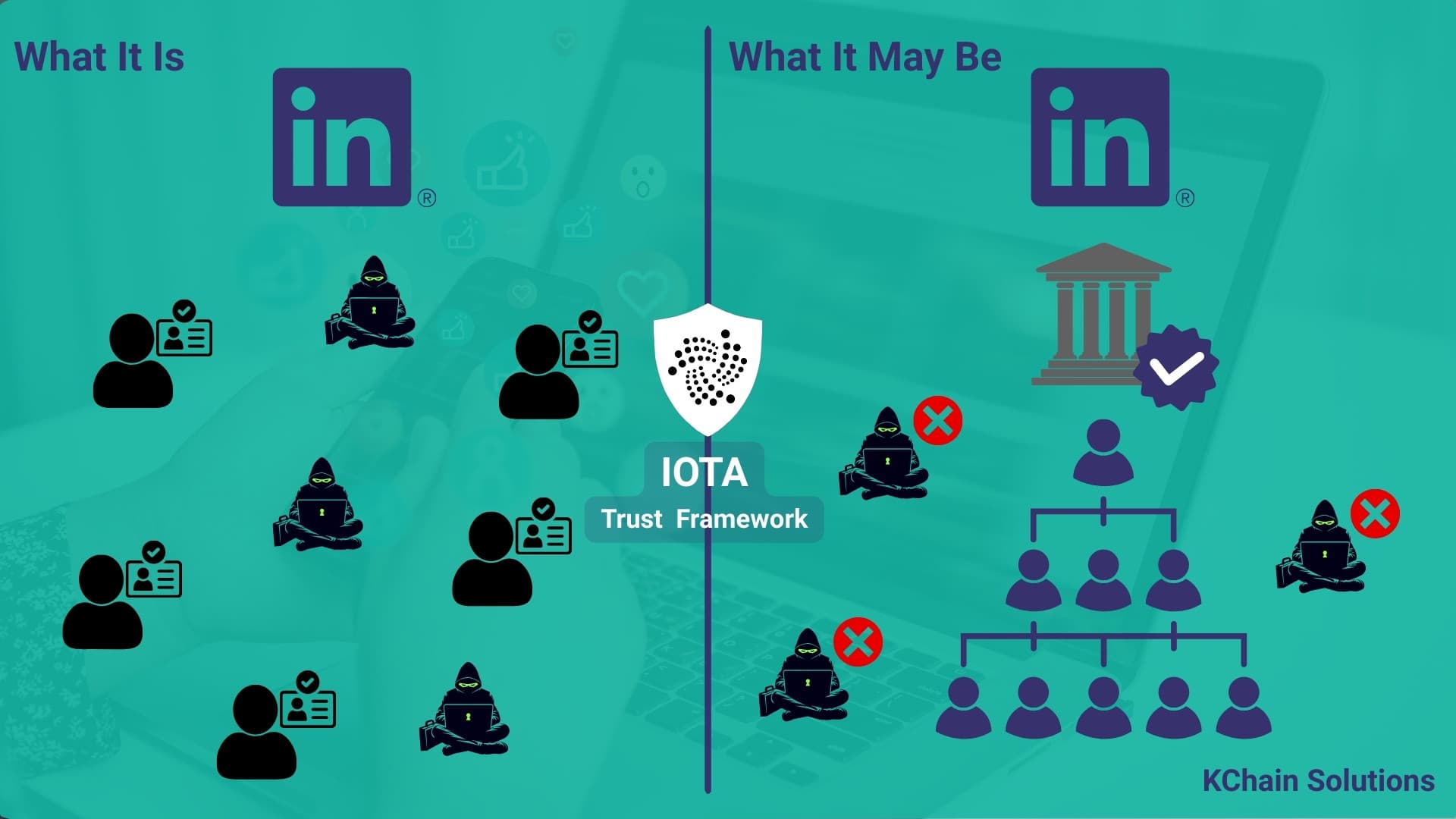
Organizations often encounter resistance to blockchain adoption due to a common misconception: that it requires replacing established business processes. The reality is different. The IOTA Trust Framework is designed to augment rather than replace existing systems, allowing enterprises to extend their operational capabilities while meeting regulatory and compliance requirements.
This article breaks down each of the five core building blocks, explains how they work together through integration patterns, and highlights the enterprise use cases where the framework delivers the most value.
What is the IOTA Trust Framework?
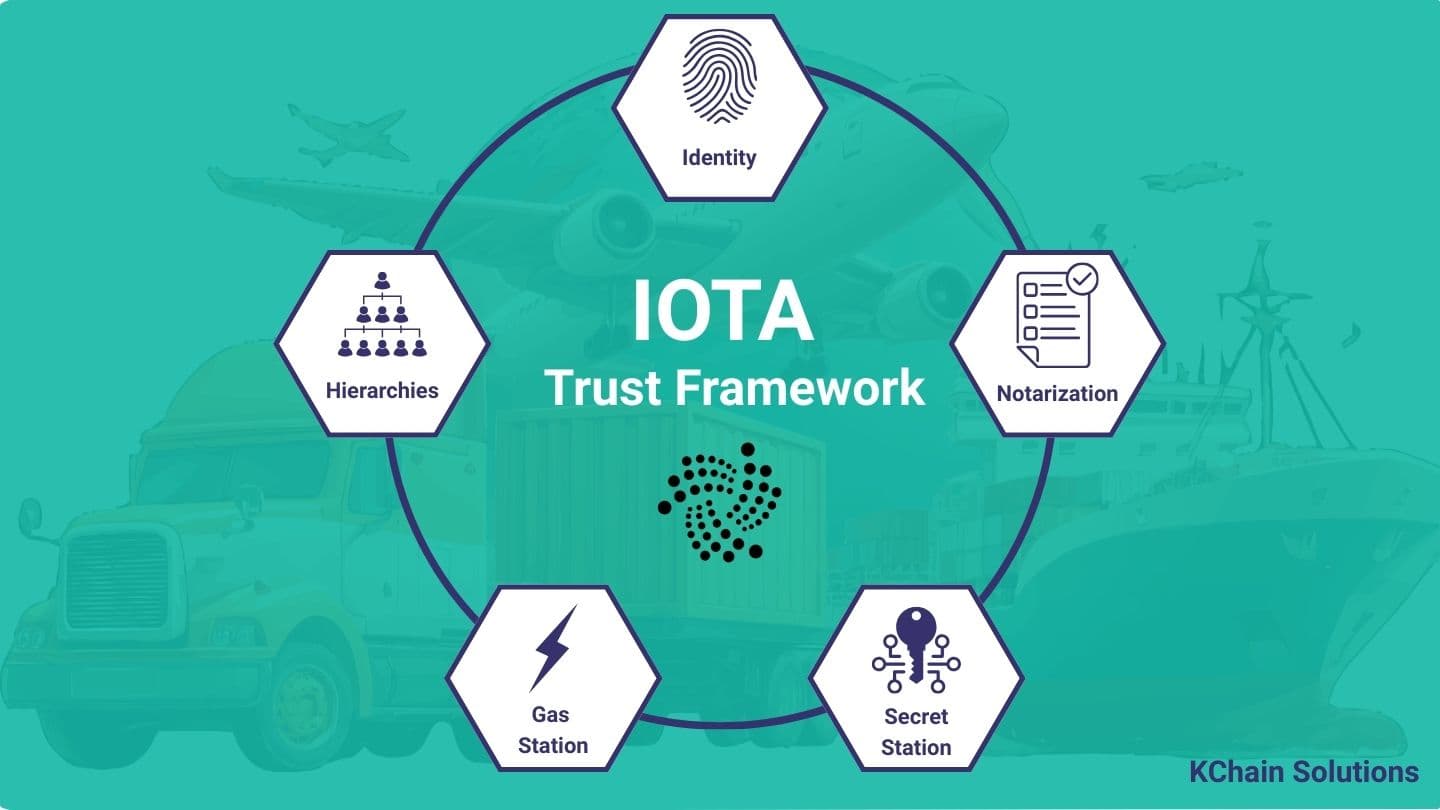
The IOTA Trust Framework is an open-source suite of modular products that address a fundamental enterprise problem: how do you establish, verify, and manage trust across organizational boundaries without relying on a single centralized authority?
Traditional approaches (centralized databases, point-to-point integrations, manual verification processes) create bottlenecks, inefficiency, single points of failure, and compliance gaps. The IOTA Trust Framework lowers the barrier to building on the IOTA blockchain and mitigates the risks of developing custom smart contracts, giving enterprises production-ready components for trust infrastructure.
Each product is architected as a standalone module while maintaining composability with other components. This means you can start with one product and extract compounded value as you integrate additional modules over time.
Key characteristics:
- Open source - No vendor lock-in, full auditability
- Low transaction costs - Approximately 0.005 IOTA per transaction, critical for high-volume enterprise workloads
- W3C standards compliant - DIDs, Verifiable Credentials, interoperable by design
- MoveVM smart contracts - Stronger security guarantees than EVM
- Modular architecture - Use only the products you need
- TypeScript and Rust SDKs - Developer-friendly bindings for both languages
By leveraging these framework components, organizations avoid the risks and maintenance costs associated with implementing custom smart contracts.
The 5 Core Building Blocks
1. IOTA Identity
IOTA Identity implements industry-standard patterns (W3C) for Decentralized Identity in both a DLT-agnostic and IOTA method-specific manner. It provides identity primitives for people, organizations, devices, and digital objects, establishing a unified trust layer across all actors in the ecosystem.
How it works:
- Organizations create DIDs (Decentralized Identifiers) anchored on IOTA
- Credentials are issued as W3C Verifiable Credentials
- Holders store credentials in wallet applications
- Verifiers can independently validate credentials without contacting the issuer
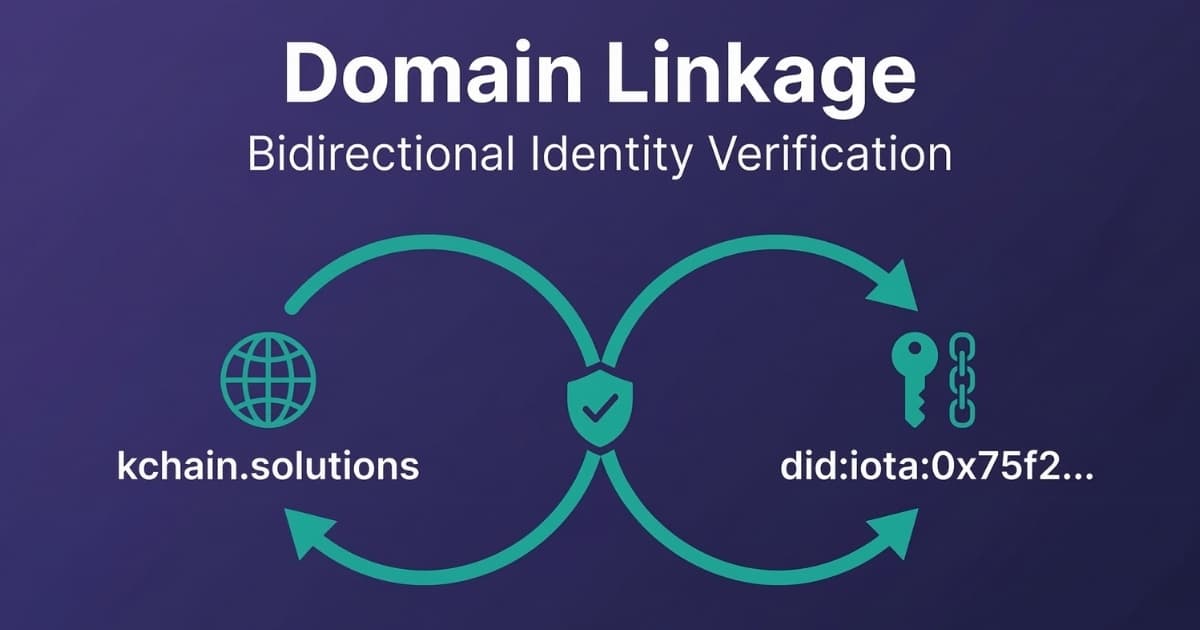
- Domain linkage provides attestation of real-world identity for a specific DID
Enterprise applications:
- Employee credential management
- Supply chain participant verification
- Customer KYC with reusable credentials
- IoT device identity and authentication
2. IOTA Hierarchies
IOTA Hierarchies defines structured relationships and delegated authorities among participants such as parent companies, subsidiaries, and certification bodies. This component can operate as an on-chain access control manager, enforcing role-based permissions across IOTA Audit Trails or custom smart contracts.
How it works:
- Root authorities define the trust hierarchy
- Structured relationships map parent companies, subsidiaries, and partners
- Roles are associated as attributes to IOTA addresses
- Permission levels (Write, Admin, Read-only) are enforced at the smart contract level
- A single source of truth extends horizontally across multiple components
Enterprise applications:
- Multi-party supply chain authority management
- University credential issuance systems
- IoT device fleet hierarchies
- Regulatory body accreditation chains
- Role-based access control for on-chain applications
3. IOTA Notarization
IOTA Notarization secures the integrity and timestamp of critical trade data (invoices, bills of lading, certificates) by anchoring cryptographic proofs on-chain. The framework supports three notarization patterns:
- Locked Notarization - An immutable proof point anchored on-chain. Once created, it cannot be modified.
- Dynamic Notarization - A mutable, versioned state record that reflects the latest update. Useful when the state of a document or asset evolves over time.
- Audit Trails - An immutable event chain where multiple actors contribute updates on-chain. Ideal for Digital Product Passport and supply chain scenarios where a complete history of events must be traceable.
Enterprise applications:
- Digital Product Passport lifecycle tracking
- Regulatory compliance documentation
- Supply chain provenance verification
- Contract and agreement notarization
- Trade document integrity (invoices, bills of lading)
4. IOTA Gas Station
IOTA Gas Station enables transaction fee sponsorship, allowing users to interact with on-chain applications without holding native tokens. This removes the biggest barrier to enterprise blockchain adoption: requiring end users to purchase and manage cryptocurrency.
How it works:
- Enterprises fund a Gas Station with IOTA tokens
- Users submit transactions without holding any tokens
- The Gas Station sponsors the transaction fees
- Beyond fee sponsorship, it provides performance optimization for coin object management, delegating operational complexity to a dedicated component
- Gas Station is natively integrated with Identity and Notarization for secure transaction signing
Enterprise applications:
- Consumer-facing blockchain applications
- Employee onboarding to enterprise systems
- Suppliers and logistics agents submitting documents or triggering transactions
- IoT device transaction automation
- Any use case where end users should not handle tokens
5. IOTA Secret Storage
IOTA Secret Storage enables applications to securely request cryptographic signatures without exposing private keys. It provides a standardized, auditable interface for transaction approval, identity verification, and data signing, maintaining key security while offering developers the flexibility to integrate existing key management solutions.
How it works:
- Applications request cryptographic signatures through a standardized interface
- Private keys are never exposed to the application layer
- Supports integration with enterprise key management infrastructure
- AWS connector coming soon, HashiCorp Vault connector in the pipeline
Enterprise applications:
- Secure transaction signing for automated workflows
- Identity verification without key exposure
- Integration with existing enterprise HSM/KMS infrastructure
- Auditable signing operations for compliance
Trust Framework Integration Patterns
The real power of the IOTA Trust Framework emerges when products are combined. Here are the key integration patterns:
Gas Station + Secret Storage (Infrastructure Layer)
Gas Station and Secret Storage operate at the infrastructure layer and can be composed with all other modules. Gas Station provides not only transaction fee sponsorship but also performance optimization for coin object management. Combined with Secret Storage, enterprises get a complete infrastructure for signing and submitting transactions without exposing keys or requiring users to manage tokens.
Hierarchies + Audit Trails (Permission-Controlled Event Chains)
In audit trail scenarios, different roles require different permission levels (Write, Admin, Read-only). Hierarchies associates roles as attributes to IOTA addresses, enabling a single source of truth to be extended horizontally across multiple components while guaranteeing correct permission enforcement for Audit Trails. This pattern is essential for multi-party supply chain tracking.
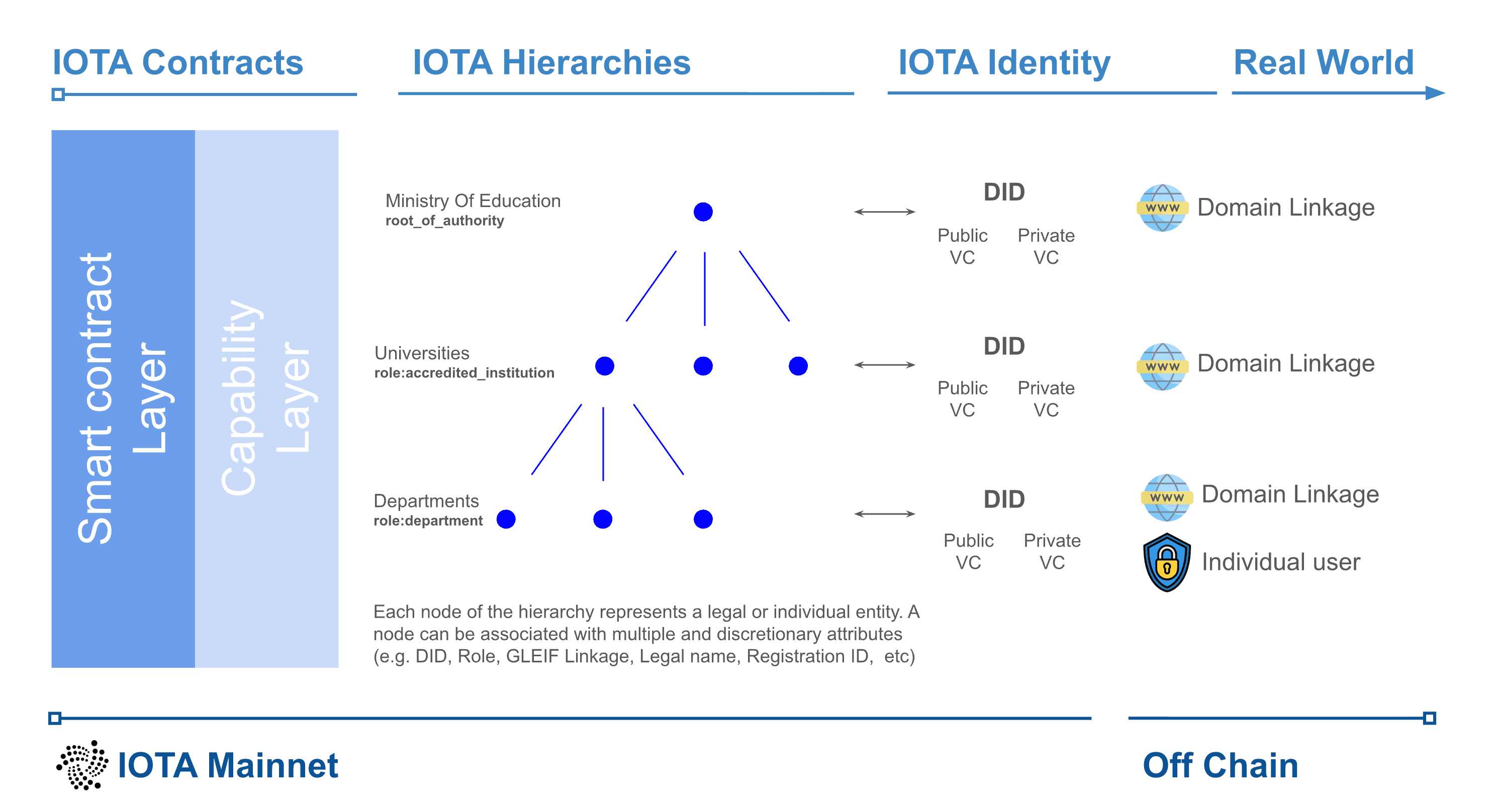
Identity + Hierarchies (WHO + WHAT)
When IOTA Identity is combined with domain linkage, it provides attestation of real-world identity for a specific DID. For business entities, the DID establishes WHO the actor is behind their on-chain identity.
This DID can then be configured as an address attribute within Hierarchies, creating an organizational structure that maps relationships between entities and establishes credential chains showing exactly WHO accredited WHOM for a particular role.
In summary: Identity attests WHO an entity is, while Hierarchies defines WHAT role that entity plays within the ecosystem.
Putting It All Together: Digital Product Passport
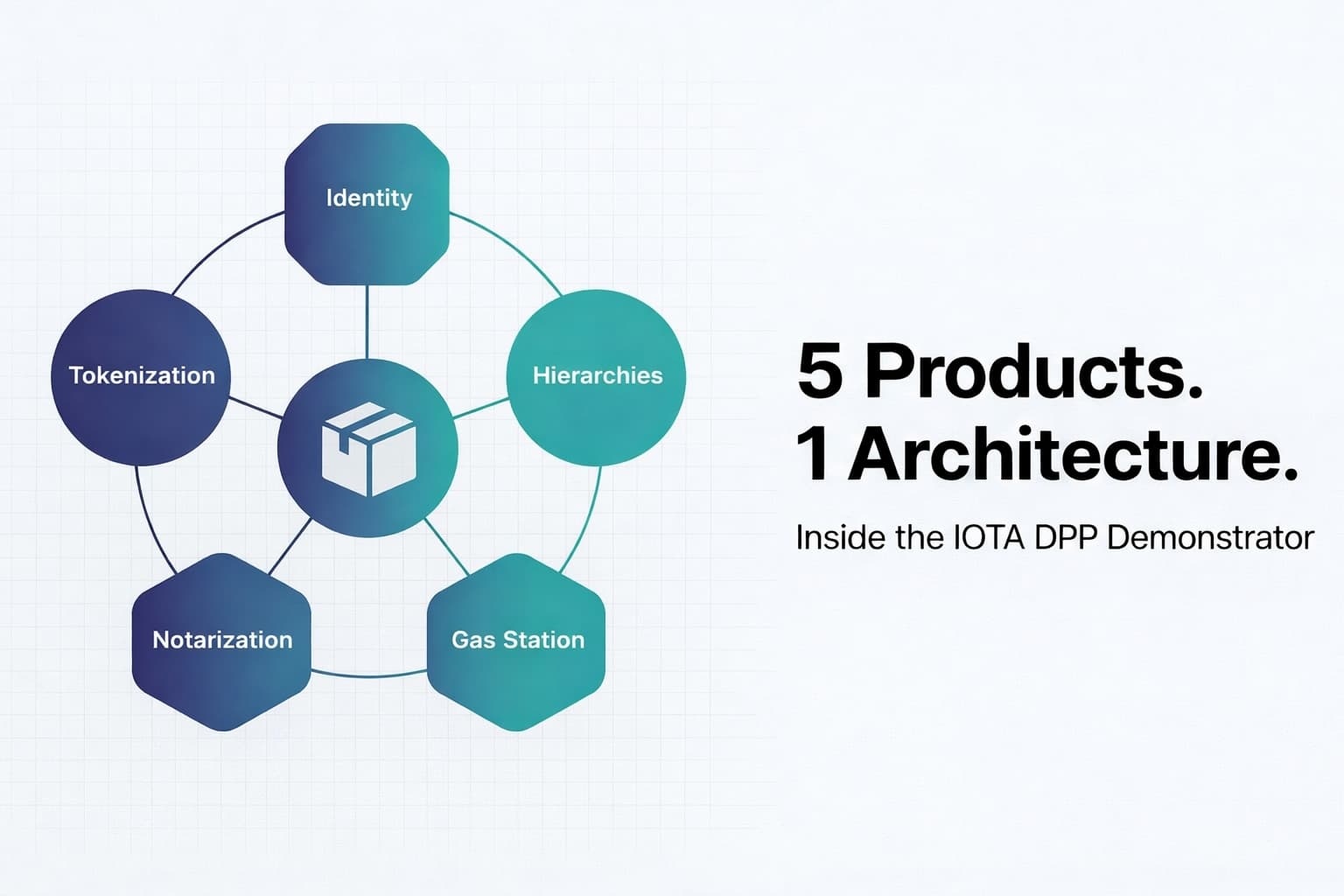
Consider a Digital Product Passport implementation that combines all five products:
- IOTA Identity - Manufacturer, suppliers, and recyclers each have verified DIDs with domain linkage
- IOTA Hierarchies - The regulatory body delegates authority to national agencies, who onboard all ecosystem participants (manufacturers, suppliers, recyclers, certified auditors) as accredited nodes with role-based permissions
- IOTA Notarization - Every product lifecycle event (manufacturing, shipping, recycling) is recorded as an immutable Audit Trail
- IOTA Gas Station - Supply chain workers interact with the system without managing cryptocurrency
- IOTA Secret Storage - Transaction signing is handled securely without exposing keys to the application layer
You can explore a comprehensive demonstration of how these products integrate together at the official IOTA DPP showcase.
Why Enterprises Choose IOTA
Near-zero transaction costs - At approximately 0.005 IOTA per transaction, costs are orders of magnitude lower than Ethereum or Polygon. For high-volume enterprise workloads (supply chains processing millions of events), this is a fundamental economic advantage. Gas Station can abstract these costs entirely for end users.
Open-source, non-profit governance - The IOTA Foundation is a German non-profit. No commercial entity can extract rents from your infrastructure or change terms unilaterally.
W3C standards compliance - DIDs and Verifiable Credentials are W3C standards with growing adoption across governments and enterprises. Building on standards protects your investment.
MoveVM security - Move's resource-oriented programming model prevents entire classes of smart contract vulnerabilities common in EVM (reentrancy, integer overflow). For high-value enterprise applications, this security advantage matters.
No custom smart contracts needed - The modular Trust Framework products eliminate the risks and maintenance costs of implementing custom smart contracts for common trust patterns.
Getting Started
Implementing the IOTA Trust Framework requires careful architecture planning. The framework is powerful but modular: most enterprises start with one or two products and expand as their needs evolve.
Common starting points:
- Digital Product Passport compliance - Start with Identity + Notarization + Hierarchies
- Credential management - Start with Identity + Hierarchies (WHO + WHAT pattern)
- Document integrity - Start with Notarization (Locked or Dynamic patterns)
- User experience - Start with Gas Station + Secret Storage (infrastructure layer)
Official resources:
- IOTA Identity docs
- IOTA Hierarchies docs
- IOTA Notarization docs
- IOTA Gas Station docs
- IOTA Secret Storage
- DPP Demo showcase
Need help designing your IOTA Trust Framework architecture? Our team has hands-on experience with all five products and their integration patterns.
Request a Free ConsultationConclusion
The IOTA Trust Framework represents a mature, production-ready approach to enterprise trust infrastructure. With near-zero transaction costs, W3C compliance, modular architecture, and strong security guarantees, it addresses the core requirements that have held enterprise blockchain adoption back.
The key insight is that blockchain should augment, not replace, existing systems. The Trust Framework's modular design lets enterprises start small, prove value quickly, and expand as needs evolve without the risk of custom smart contract development.
The key is starting with the right architecture. Not every use case needs all five products, and implementation sequencing matters. An architecture-first approach, understanding the problem deeply before selecting technology, consistently delivers better outcomes than technology-first experiments.
Need help implementing IOTA Trust Framework?
Schedule a free consultation to explore how KChain Solutions can help your organization implement production-grade blockchain architecture.

Valerio Mellini
Founder & IOTA Foundation Solution Architect
10+ years in software architecture across Accenture, PwC, Wolters Kluwer, and Ubiquicom. Certified Blockchain Solutions Architect. Helping enterprises implement production-grade blockchain systems with architecture-first methodology.